What is the difference between lead-acid batteries and lithium batteries?
2024-07-10
Nowadays, the trend of new energy is sweeping the world. Batteries can be seen very commonly in daily life, but can you distinguish the difference between battery types? Here we will take you to a simple method to teach you to correctly understand lead-acid and lithium batteries.
1. Distinguish them from the materials:
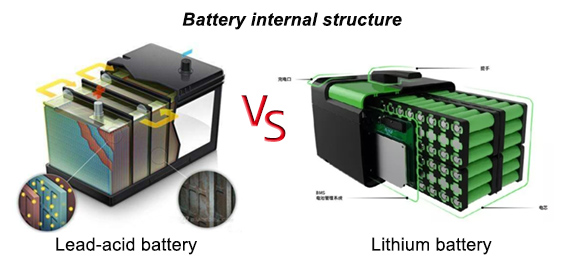
As the name implies, lead-acid batteries are made of materials such as lead and sulfuric acid; lithium batteries are made of materials such as lithium alloy metal oxides.
As the name implies, lead-acid batteries are made of materials such as lead and sulfuric acid; lithium batteries are made of materials such as lithium alloy metal oxides.
2. Distinguish them from the internal structure:
Lead-acid batteries are made of separator paper wrapped with positive and negative plates coated with lead paste, plus sulfuric acid; lithium batteries are made of multiple 18650 or other types of cylindrical cells to form a battery pack.
Lead-acid batteries are made of separator paper wrapped with positive and negative plates coated with lead paste, plus sulfuric acid; lithium batteries are made of multiple 18650 or other types of cylindrical cells to form a battery pack.
3. Distinguish them from the weight under the same voltage state:
Generally, a single lead-acid battery is 12V. If it is adapted to a voltage of 48V, four 12V lead-acid batteries need to be connected in series to increase the voltage to form a battery pack to reach a voltage state of 48V, but the weight will also increase; however, lithium batteries (NMC) can form a battery pack with 13s 18650 cells to reach a voltage state of 48V, so the weight is very light.
Generally, a single lead-acid battery is 12V. If it is adapted to a voltage of 48V, four 12V lead-acid batteries need to be connected in series to increase the voltage to form a battery pack to reach a voltage state of 48V, but the weight will also increase; however, lithium batteries (NMC) can form a battery pack with 13s 18650 cells to reach a voltage state of 48V, so the weight is very light.
4. Distinguish them from the charging voltage:
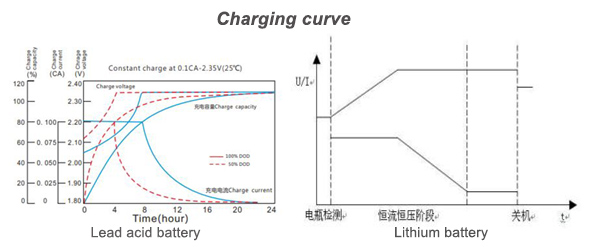
The charging method of lead-acid batteries adopts constant voltage charging and cyclic charging. The nominal voltage of a single cell of lead-acid battery is 2.0V, the maximum charging voltage is 2.4V, and the over-discharge voltage is 1.5V.
The charging method of lithium batteries is voltage-limited constant current. Among them, lithium batteries are divided into ternary lithium batteries (NMC) and lithium iron phosphate batteries (LFP), so the charging voltage of their single cells is also different. The rated voltage of a single NMC cell is 3.6V, the maximum charging voltage is 4.2V, and the over-discharge voltage is 2.75V. The rated capacity of a single LFP cell is 3.2V, the maximum charging voltage is 3.65V, and the over-discharge voltage is 2.5V.
The charging method of lead-acid batteries adopts constant voltage charging and cyclic charging. The nominal voltage of a single cell of lead-acid battery is 2.0V, the maximum charging voltage is 2.4V, and the over-discharge voltage is 1.5V.
The charging method of lithium batteries is voltage-limited constant current. Among them, lithium batteries are divided into ternary lithium batteries (NMC) and lithium iron phosphate batteries (LFP), so the charging voltage of their single cells is also different. The rated voltage of a single NMC cell is 3.6V, the maximum charging voltage is 4.2V, and the over-discharge voltage is 2.75V. The rated capacity of a single LFP cell is 3.2V, the maximum charging voltage is 3.65V, and the over-discharge voltage is 2.5V.
5. Distinguish them from the over-discharge voltage protection method:
The over-discharge voltage protection method of lead-acid batteries is controlled by the controller, while the over-discharge protection method of lithium batteries is controlled by BMS.
The over-discharge voltage protection method of lead-acid batteries is controlled by the controller, while the over-discharge protection method of lithium batteries is controlled by BMS.
6. Distinguish them from the charging current:
The charging current of lead-acid batteries is generally between 0.15-0.18C, while the charging current of lithium batteries is generally between 0.2-0.5C. Different charging currents will result in different compatible chargers.
The charging current of lead-acid batteries is generally between 0.15-0.18C, while the charging current of lithium batteries is generally between 0.2-0.5C. Different charging currents will result in different compatible chargers.
What is a deep cycle battery